Life Cycle Assessment (LCA)

LCA is a methodology used to evaluate the environmental impacts of a product, process, or service throughout its entire life cycle (ISO 14040:2006).

Why Complete an LCA: Address the environmental footprint, discover hotspots in an existing or prospective product, process, or service throughout the full life cycle, benchmark your product, meet reporting requirements, and comply with EU regulations.


The Problem: LCA studies require emission factors from hundreds of material categories, and transparent supplier data can be notoriously difficult to attain.


The Solution: A background database like ecoinvent can fill data gaps and help experts to produce more realistic impact assessments.


Why ecoinvent: Our environmental database is a globally trusted and annually updated resource with over 26,000 datasets, enabling complete LCA models even with limited primary data.
What Is Life Cycle Assessment (LCA)?

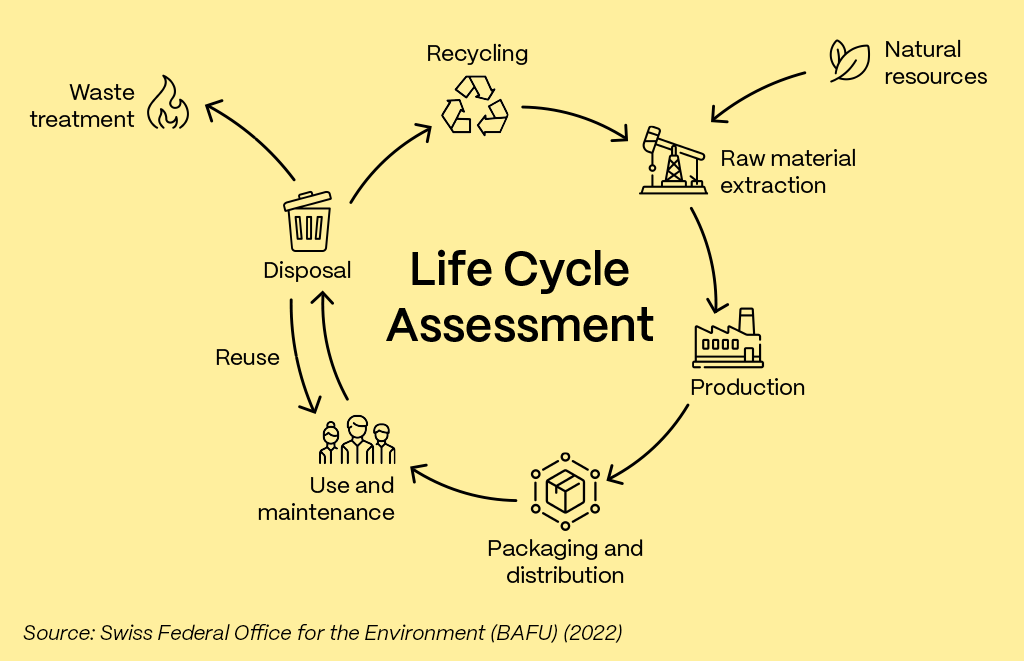
LCA considers the various stages of a product’s life, including raw material extraction, manufacturing, distribution, use, and disposal.

a graphic showing Life Cycle Assessment and a circular economy

It accounts for a wide range of environmental factors, such as energy consumption, greenhouse gas emissions, water usage, waste generation, and other potential impacts on ecosystems and human health.


ecoinvent is a comprehensive global database providing life cycle inventory (LCI) data for conducting LCA studies.


A life cycle assessment contains information on the inputs, outputs, and potential environmental impacts associated with various processes and activities across different industries. The ecoinvent database is extensively used by researchers, businesses, and policymakers to assess the environmental performance of products and systems.


We offer a standardized and transparent database for sustainability teams, including LCA practitioners, consultants, and tool developers, by providing consistent and up-to-date data on energy, material and resource consumption, emissions, and wastes associated with different activities.


Our wide range of sectors includes building and construction, chemicals and plastics, waste, and many more. Our users can access reliable, transparent, and relevant information for conducting comprehensive LCA studies and making informed decisions regarding environmental sustainability.


Watch the video below for a more visual explanation:

Video: What is Life Cycle Assessment?
A yellow graphic with the ecoinvent branding. Text reads, 'What is Life Cycle Assessment? LCA'

The Four Stages of LCA

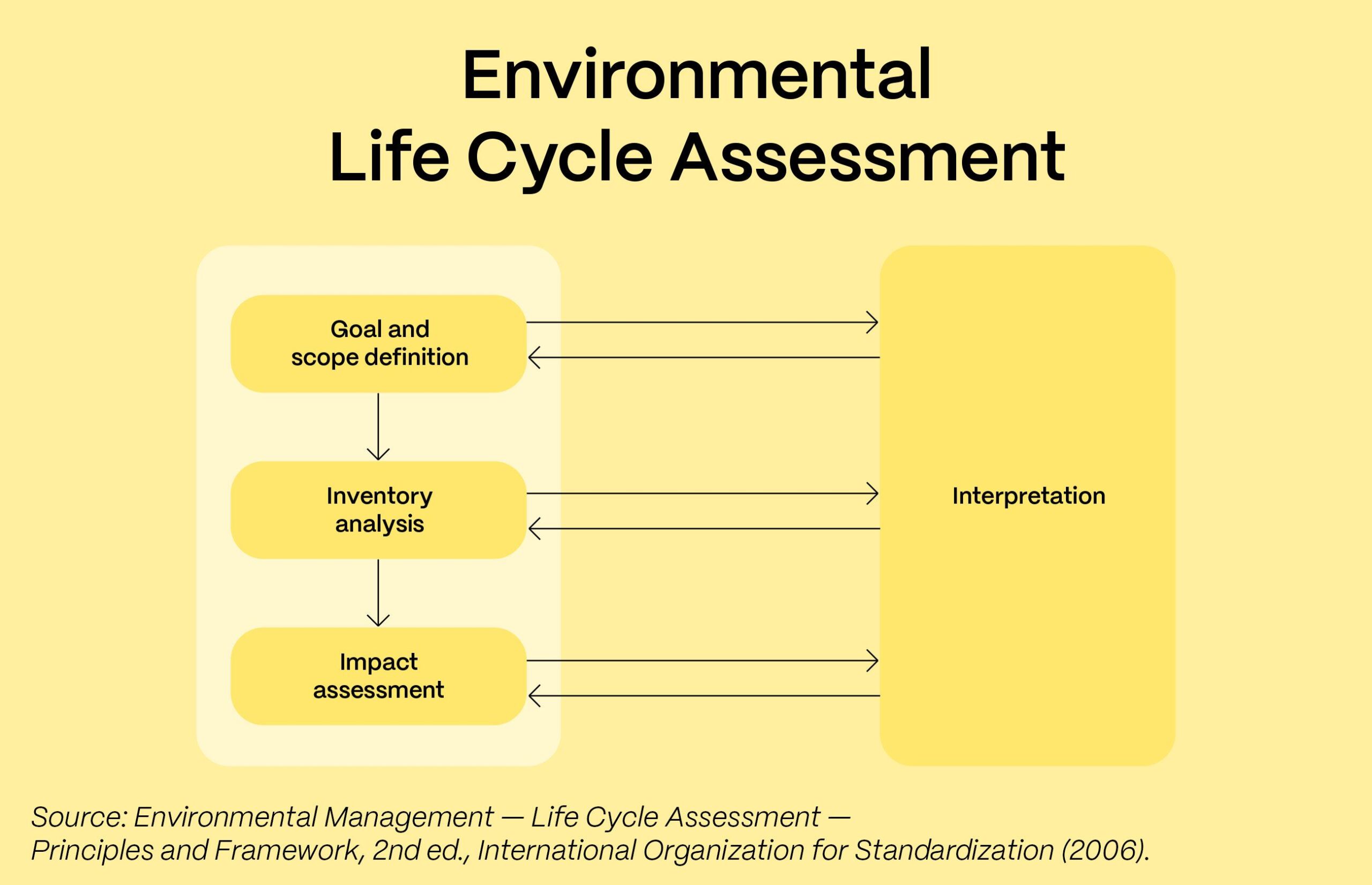
A life cycle assessment is a complex study of a product or process that reveals potential environmental impacts. It consists of  four stages (ISO 14040:2006).


First, the goals and scope of the study are defined.


Second, an inventory analysis is undertaken to quantify the polluting emissions and resource use.


Third, the impact assessment calculates the potential environmental impacts of the inventoried emissions and resource consumption.


The interpretation phase evaluates the findings from the inventory analysis and impact assessment together against the study’s original goal and scope. This results in conclusions, explanations of limitations, and recommendations for decision-makers.


The interpretation phase is often iterative, sometimes prompting a review or revision of the scope and data quality, and aims to present the overall LCA results in a way that is clear, complete, and consistent.

Within each of the four stages of LCA, there are many details and checks that experts must follow to create a robust, high-quality life cycle assessment—including where to find the supporting data.


As a background database, ecoinvent significantly supports the inventory analysis stage, where emissions and resources are quantified, and those inputs affect the results discovered in the impact assessment and interpretation phases.

System Boundaries in LCA

System boundaries are defined according to the goal and scope of a study in the first phase, with the definition of the functional unit. The system boundary details the beginning and end points of the study by defining which processes in the product life cycle are included or excluded.


The assessment may begin at the very start of production, referred to as the ‘cradle’, and it may conclude either at the point of the finished product, referred to as the factory ‘gate’, or at the point of disposal, referred to as the ‘grave’.


As an example, you can consider our cradle-to-gate LCA of a toothbrush.


Whether the assessment is termed ‘cradle-to-gate’, ‘cradle-to-grave’, or ‘cradle-to-cradle’ describes the study’s system boundaries. Other system boundary terms include gate-to-gate, cradle-to-customer, cradle-to-fork, and cradle-to-shelf.


ecoinvent data is best at supplying cradle-to-gate inventories. Our team is available to answer questions on how our data can support environmental assessment in your industry.

Why High-Quality LCI Data Matters

High-quality LCI data is the backbone of any life cycle assessment. Without robust data, the sustainability insights may not hold up to scrutiny. At ecoinvent, we review our data both internally and through trusted, external partners to ensure that our users are using the gold standard in life cycle inventory data.


In particular, we pride ourselves on the transparency of our datasets. Our data is traceable and available at the most basic level (an ecoinvent unit process), making it easier to identify the sources of environmental impacts. Access to the ecoinvent database can be acquired through an ecoinvent license.

What Is a Unit Process in ecoinvent?

A unit process is a snapshot of a single human activity, such as the production of one kilogram of wheat, or the generation of one kilowatt-hour of electricity. It records exactly what goes in (i.e., materials and energy) and what comes out (i.e., products and emissions). It is the smallest element for which input and output are quantified.

Inside the ecoinvent Life Cycle Assessment Database

The ecoinvent database provides comprehensive data originating from different sources, including companies, industrial associations, and research institutes.


Covering a diverse range of sectors and containing more than 26,000 datasets modeling human activities and processes, our database is trusted by experienced professionals. View our partners.


Every year, the database is updated to include new and improved data, as well as technical improvements. Technical support is available on our Knowledge Base.


For more information and insights on the ecoinvent database, book a demo call with our revenue team.

How to Use ecoinvent Data in a Life Cycle Assessment

An ecoinvent license is required to use our data in a life cycle assessment.


You may purchase the ecoinvent database directly from us to use in your next assessment, or, if you are using an LCA software or ecodesign tool, your license and updates are handled by the seller of the software or tool.


ecoinvent data is particularly useful when building the inventory for your assessment. As a background database, we provide datasets that help you fill gaps in your inventory with precise, regionalized, and transparent data.

Real-World Applications: LCA in Action

Companies use LCA to:

  • Conduct hotspot analysis and supply chain analysis.
  • Employ eco-design to reduce environmental impacts early in product development.
  • Benchmark your product’s performance against competitors.
  • Inform procurement decisions by comparing suppliers or materials.
  • Support green claims.
  • Meet customer, investor, or mandatory reporting requirements.
  • Support EPD (Environmental Product Declaration) certification.
  • Comply with EU regulations such as the Green Deal, CSRD, or the Ecodesign for Sustainable Products Regulation.

Companies employ life cycle assessment studies to discover and improve supply chain weak points concerning their environmental performance, as well as to comply with mandatory regulations requiring transparent reports on emissions.

Discover LCA Software & Tools

We partner with experienced software providers to meet your unique needs, including providers of eco-calculators, eco-design software, and more. With the right tool, you can better leverage our data to discover sustainable solutions tailored to your needs.

LCA Examples from ecoinvent

The insights gained from a life cycle assessment study provide the foundation for sustainable action. In our case studies, we show examples of how ecoinvent life cycle data can be used to discover hotspots in supply chains, which can lead to more sustainable decision-making for a greener future.

Discover our LCA of a Toothbrush

Unlocking carbon insights on a real, bamboo toothbrush. Watch the video on our blog now for an example cradle-to-gate analysis.

Discover our LCA of a Chocolate Bar

We save the planet more effectively when we work together. Learn more about how we teamed up with our partner, PRé Sustainability, to showcase how ecoinvent data can be used to reveal the impacts of an average 100g chocolate bar.

Access ecoinvent’s LCA Database

Access to the ecoinvent database is acquired through a valid license. You can purchase a license directly from us or through one of our partners.


For a company of our size, conducting robust LCAs would be extremely challenging without access to high-quality background databases such as ecoinvent. These datasets provide the reliable environmental information needed to assess materials, components, and processes throughout our products’ life cycle.

Björn Jung, Sustainability Manager at Thermoplan

Consider our licensing options today to access our data on the environmental impacts of activities and products across all industrial sectors.


Our license types support individuals, organizations, academia, and developers. Explore now.

Access ecoinvent data

Our licenses

Have questions? Our team is available to help you.