We also hosted a webinar in November to provide a more detailed, technical introduction to version 3.12.
The recording is now available on our Knowledge Base.


Agricultural, fisheries, and livestock systems play a vital role in biodiversity conservation, biogenic carbon balance and sequestration, and generate value across local and global economies. However, according to IPCC’s Special Report on Climate Change, Desertification, Land Degradation, Sustainable Land Management, Food Security, and Greenhouse Gas Fluxes in Terrestrial Ecosystems, agriculture is responsible for approximately 23% of all human-induced greenhouse gas emissions.
Understanding the many impacts of the processes involved in this sector, of which greenhouse gas emissions are included, can help organizations choose more sustainable outcomes in their value chains.
To achieve a better understanding, ecoinvent data is used by industries, researchers, and policymakers to form a robust foundation for environmental assessments, innovation, and evidence-based decision-making.
In our latest video, which you can watch below, our agriculture, fisheries, and animal husbandry sector experts at ecoinvent, Francesco Cirone and Andreas Giakoumatos, provide an overview of the ecoinvent database and its developments.
Our database contains over two thousand datasets for agriculture, fisheries, and animal husbandry, covering over four thousand unit processes. This sector plays a central role in ensuring food security, nutrition, and human health, and includes more than 1,200 datasets for crops, more than 900 datasets for fertilizers, pesticides, machinery related to agriculture and irrigation, and almost 200 datasets for animal husbandry and fisheries. This data supports life cycle assessments for various products and services, enabling sustainable decision-making in the value chain.
Within the sector, and of great importance to scientific impact assessments, are several main challenges, such as improving pesticide emission models or balancing biogenic carbon. Our agriculture sector experts are contributing to the discussion through their work on several methodological advancements to improve the data modeling on this topic. They aim to support users in managing the accountability of emissions more precisely.
Our mission is to promote and support the availability of high-quality environmental data worldwide to support informed sustainability decisions.
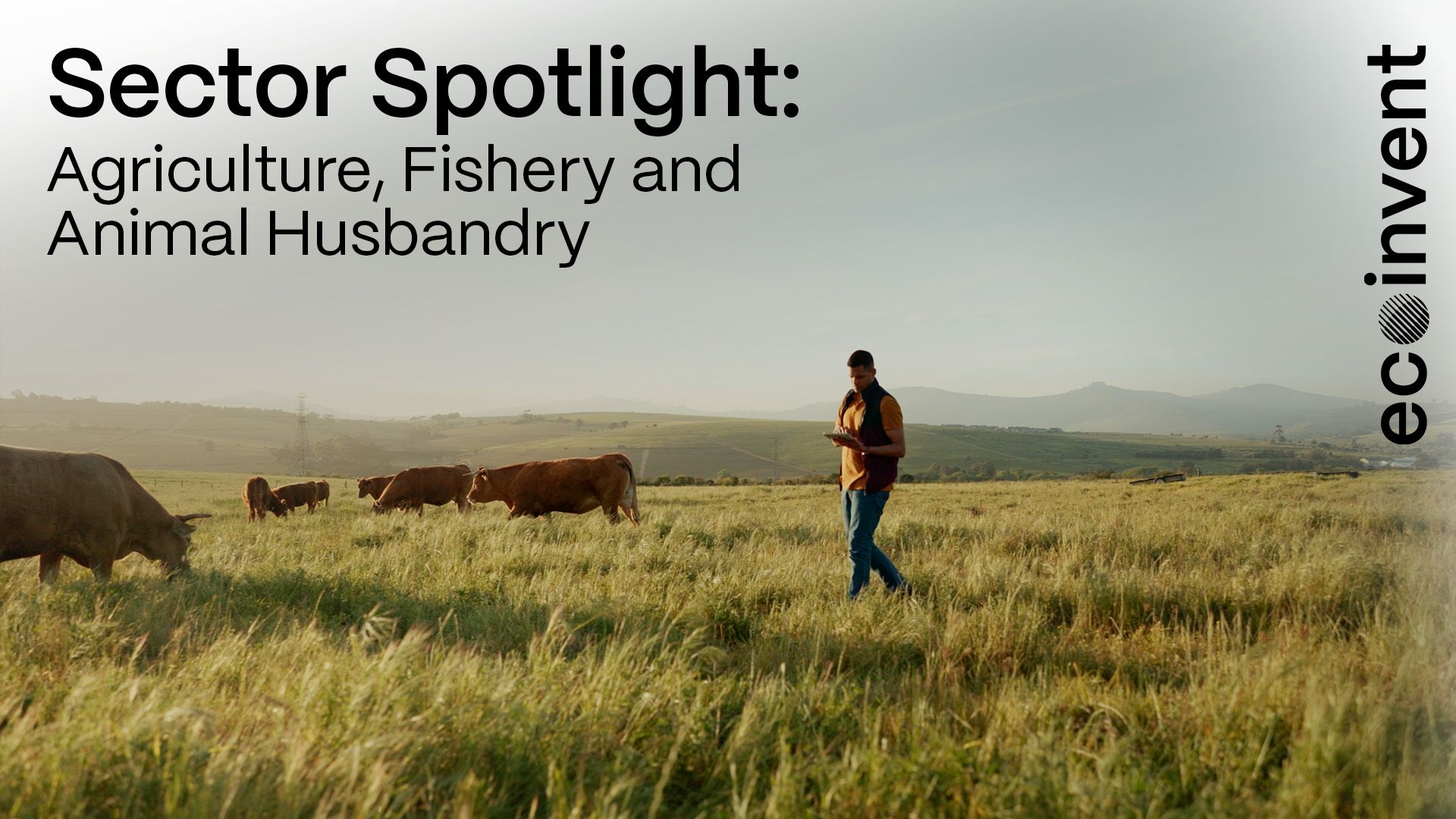
Discover the agriculture, fisheries, and animal husbandry sector of the ecoinvent database to learn about how our data supports sustainable decision-making for a greener future.

Persefoni is a leading Sustainability Management SaaS and AI platform, designed to meet escalating regulatory and stakeholder expectations around sustainability. They help companies and financial institutions to measure and manage carbon emissions with precision, to generate trustworthy and audit-ready sustainability reports, and to engage supply chains for decarbonization strategies.
In this interview, Caroline explains the benefits for clients when integrating ecoinvent’s detailed life cycle data into Persefoni software to enhance supply chain assessments. Her experience in guiding clients through their carbon accounting journeys shines through in her responses, which always keep the client in mind.
Read on to discover where Persefoni meets ecoinvent.
My path into sustainability began with a love for ecology and conservation biology, which shaped my academic focus. However, I quickly realised that achieving real, wide-reaching impact required working with businesses to help transform their practices. Nearly two decades ago, I transitioned into environmental consulting before recognising that scalable impact would come through technology—making high-quality emissions data accessible to every organisation.
The climate reporting landscape is constantly evolving, and staying aligned with the latest science and standards is critical. In my role, I guide clients along their carbon accounting journeys—whether they’re just getting started and need foundational support, or are more advanced and seeking to refine complex, detailed analyses.
Equally important is ensuring our software evolves in step with regulatory changes. Together with our team of climate experts, I help feed market insights and client needs back into our Product team, ensuring Persefoni remains ahead of the curve.
Our platform simplifies carbon accounting by streamlining data ingestion and delivering fast, accurate GHG calculations using globally recognised methodologies like the GHG Protocol and PCAF. Built-in artificial intelligence (AI) automatically flags anomalies and processes thousands of transactions in seconds, removing the need for manual interventions behind the scenes.
Insights are presented through intuitive dashboards and automated reports aligned with leading frameworks and standards such as the CSRD, CDP, and SECR, enabling clients to move from data to disclosure with confidence.
ecoinvent is widely regarded as one of the most robust and trusted sources of life cycle GHG emissions data (amongst other data!). It was important to Persefoni to ensure our customers could access this level of granularity and transparency.
Persefoni clients typically use ecoinvent to enhance supply chain assessments, enabling them to identify emissions from specific purchases (across thousands of products, components, or raw materials, to name a few). This allows for a more refined, process-specific view of emissions.
Data is the most common challenge. Knowing where to source it, how to process it, and which emissions factors to apply. Persefoni addresses these challenges in several ways:
– Accessibility: We offer Persefoni Pro, a free, self-guided carbon accounting tool available to any organisation. It runs on the same calculation engine as our enterprise platform, democratising access to high-quality emissions measurement. It also enables supplier and portfolio engagement to enhance Scope 3 data quality.
– Breadth of data: Our platform includes over 150,000 emission factors, from global spend-based models to regional databases and granular LCA datasets like ecoinvent, ensuring organisations can use the most appropriate data for their needs.
– Expert support: Our climate experts and Customer Success teams are always available to assist clients in improving data quality, methodologies, and output accuracy.
It’s essential that customers have access to a broad range of emissions data to meet them where they are on their climate journey. For those just starting out, who may not yet have access to detailed or granular data, broad datasets help them understand the materiality of their impacts and identify where to focus their efforts.
However, that’s only the first step for many organisations. For companies looking to truly decarbonise or set and achieve science-based targets, it becomes critical to go beyond averages and access datasets that distinguish between different technologies and processes.
This is where premium datasets like ecoinvent add significant value. Many of our clients operate in complex sectors such as manufacturing or chemicals, where even small variations in ingredients or production methods can result in substantial differences in emissions. Having access to detailed, process-specific data enables these organisations to pinpoint those differences and make more informed, impactful decisions.
Data transparency is no longer a ‘nice to have’ in carbon accounting. Many Persefoni clients use our platform to meet regulatory reporting obligations, and data audits are becoming standard practice. That means the emission factors used, as well as the methodologies applied, are often checked and challenged.
Transparency is embedded in the foundation of Persefoni’s platform. Clients maintain full ownership of their data, including every decision around methodology and emission factor selection. All transactions are captured within our Carbon Ledger—a fully downloadable, audit-ready record of every data point uploaded. This includes details such as original inputs, applied conversions, selected emission factors, and a complete audit trail showing user IDs, timestamps, and any edits made.
This level of transparency not only supports compliance—it also builds trust, improves data quality, and ultimately enables organisations to take credible climate action with confidence.
Spend-based analysis is often a useful starting point for estimating emissions, particularly for companies early in their carbon accounting journey. It works by multiplying the amount a company spends on a good or service by a relevant spend-based emissions factor, often derived from environmentally extended input-output models. This approach offers a high-level view of emissions, particularly across the supply chain, but it comes with limitations. Critically, it assumes that all suppliers and products within a given sub-sector have similar carbon intensities, which is rarely the case in reality.
Unit-based accounting, on the other hand, uses actual quantities, such as kilograms of material or litres of ingredient, to estimate emissions. Because it’s based on physical activity rather than financial spend, it is not distorted by price fluctuations, inflation, or procurement dynamics. When paired with high-quality life cycle assessment (LCA) data, like that provided by ecoinvent, unit-based analysis enables far greater precision, offering emissions factors that are specific to particular technologies, production methods, and geographies.
To illustrate the difference: imagine purchasing one tonne of fabric. A spend-based approach might apply the same emissions factor per euro or pound spent, regardless of whether the fabric is cotton or silk, whether it was purchased at a premium due to demand spikes, or secured earlier at a discount. A unit-based approach, however, takes into account the specific material, production region, recycled content, and even the weave or knit, providing a much more accurate reflection of its true carbon footprint.
Most of our clients are aiming for more than just compliance-driven carbon reporting—they’re committed to actually reducing their emissions. Whether this is motivated by internal leadership, investor scrutiny, or evolving regulatory and public disclosure requirements, there’s a growing expectation for accountability and measurable progress.
For many companies, the bulk of emissions sit outside their direct operations, typically within the supply chain (though this varies by sector). This makes access to accurate, unit-based emissions data critical. It provides the level of specificity needed to set credible targets, identify material emissions hotspots, and take meaningful, data-informed steps towards decarbonisation.
At Persefoni, we’ve seen clients use granular unit-based emission factors to inform a wide range of strategic decisions, from product redesign and material selection to manufacturing process improvements and increased use of recycled inputs. By moving beyond estimates to precise, activity-based data, organisations can align carbon reduction strategies with their operational realities and drive tangible climate impact.

The GHG Protocol, widely regarded as the world’s leading greenhouse gas accounting framework, is built on five key principles: Relevance, Completeness, Consistency, Transparency, and Accuracy. Striking the right balance between completeness and accuracy is essential but can be challenging, particularly when navigating fragmented data or Scope 3 emissions.
At Persefoni, we support clients in managing this trade-off by providing access to a wide range of emissions factors and multiple methodological approaches. Many organisations begin with spend-based data to gain a comprehensive, top-down view of their emissions. This offers a high level of completeness, even if the initial accuracy is limited.
From there, clients can identify material emissions sources and begin refining their estimates using more precise, unit-based emission factors. To take it a step further, our Data Exchange module and Persefoni Pro enable companies to directly engage their suppliers and portfolio companies, unlocking supplier-specific data where available and appropriate, and further improving accuracy.
As we often say in this space, nothing is ever black and white. The most accurate and complete inventories typically blend multiple approaches. Managing that complexity manually can be resource-intensive, which is why technology is so important. Persefoni’s platform automates best practices, streamlines data management, and helps clients build GHG inventories that are not only robust and credible but also time- and cost-efficient.
Emissions accounting has advanced rapidly in recent years, and that momentum shows no sign of slowing. Amid ongoing regulatory shifts across Europe, North America, and beyond, companies that embed best practices, such as prioritising primary data and adopting precise, unit-based methodologies, are emerging as the most resilient and future-ready.
Looking ahead, we expect to see increased scrutiny and a clear move away from basic disclosure towards high-integrity climate data as a core business asset. There’s a growing convergence around international standards like those set by the ISSB, which are significantly raising expectations for transparency, traceability, and auditability.
In this next phase, organisations will need to go beyond estimates. They’ll be expected to justify methodologies, provide robust data trails, and demonstrate the use of verifiable, activity-level data. This evolution will not only enhance the credibility of climate reporting but also sharpen its strategic value, enabling more informed, accountable decision-making.
Persefoni Pro is designed to lower the barriers to entry for carbon accounting, making it possible for any organisation, regardless of size, expertise, or budget, to begin measuring and understanding their emissions. By offering a free, self-guided platform powered by the same calculation engine used by global enterprises, Persefoni Pro helps democratise access to high-quality emissions data and GHG reporting capabilities.
Its impact extends beyond individual users. Large organisations can now more easily engage their suppliers and portfolio companies in climate disclosure efforts, improving the quality and completeness of Scope 3 data across their value chains. This kind of scalable, bottom-up engagement is essential for credible decarbonisation planning.
In shaping the market, Persefoni Pro is redefining what’s expected from sustainability tools: transparency, accessibility, and alignment with global standards, all without requiring a team of experts or expensive consulting support. As reporting requirements become more widespread and stringent, tools like Persefoni Pro will play a vital role in enabling more organisations to participate meaningfully and confidently in the climate disclosure ecosystem.
One of the most accessible ways to engage with us is through Persefoni Academy, our free, on-demand learning platform designed to help organisations globally to build confidence in carbon accounting, climate disclosure, and sustainability strategy.
The Academy offers a range of expert-led courses that walk users through the fundamentals of emissions measurement, carbon accounting standards like the GHG Protocol and PCAF, and practical application of climate data in business decision-making. Whether you’re just getting started or looking to strengthen your existing knowledge, the content is structured to meet learners where they are.
It’s not just for Persefoni users; Persefoni Academy is open to anyone looking to better understand the carbon accounting landscape. It’s part of our broader mission to empower more people with the skills and knowledge needed to take credible climate action. And for those who complete the courses, certificates of completion are available to demonstrate growing expertise in this evolving field.
We also hosted a webinar in November to provide a more detailed, technical introduction to version 3.12.
The recording is now available on our Knowledge Base.
This release is the culmination of our work with our many partners from both industrial and scientific institutions. These collaborations enable us to provide high-quality, accurate data, and we are very grateful to our data providers for their efforts. You can find the full list of 3.12’s data providers here.
To learn more about how we collaborate with our data providers, read about our latest in-person meeting with local partners: Stronger Together: Our Partner Deep Dive.
Explore everything version 3.12 offers on our Knowledge Base, including detailed sector notes and supporting documentation, or contact us to learn how our latest updates can benefit your work.

Our team is available to answer your questions and help you use our database. Please select a topic from the drop-down menu to send us a message.
Building and construction is fundamental to the development of civilization, and moving the industry towards more sustainable practices is a must.
Cement is heavily relied upon for building and construction, but it has high environmental impacts and is responsible for 7-8% of all manmade carbon dioxide emissions. The journey towards reducing emissions such as these begins with robust lifecycle data.
Lifecycle data enables researchers and product designers to better understand the environmental impacts of a product or process, and this applies to buildings and construction, too. With knowledge about where the greatest impacts currently reside in the supply chain, smart decisions can be made to create a more sustainable product.
In our latest video, Enrico Bonanno (Project Manager) describes the data we have available for the building and construction sector in ecoinvent version 3.11, alongside his support for the operational processes and strategy of the database.
Our database supports life cycle assessments in the building and construction sector with over 1,500 datasets across fifteen geographic regions, documenting processes from mining construction minerals (sand, gravel, limestone, clay, gypsum) to the production of finished materials.
Watch the video now to learn more about our building and construction sector.

Interested in using the ecoinvent database? Discover our licensing options today.
Plastics must be responsibly disposed of to prevent environmental harm, and the ecoinvent database can assist in the decision-making process.
Our data enables industry leaders, policymakers, and sustainability experts to fill the gaps in their value chains, enabling more complete life cycle assessments to inform important decisions.
In this video, Avraam Symeonidis (Database Content Lead) provides an expert overview of how the ecoinvent database supports users in the waste industries, specifically regarding plastic recycling data.
Watch the video below to learn Avraam’s insights about the project we undertook with a partner to collect, validate, review, and ultimately publish environmental data related to eleven different polymers from over twenty-five recycling facilities across Europe.
Explore the waste management and recycling sector of the ecoinvent database to learn how high-quality data allows industries to better assess their environmental impacts.
There are many factors to consider when choosing chocolate. Flavor, shape, weight, cocoa percentage, and price are all important, but have you considered the environmental impact of your chocolate?
Join us on a data-driven journey from the planting of a cocoa bean to the waste treatment of the packaging. Below, we unwrap a Life Cycle Assessment (LCA) conducted by PRé Sustainability, using SimaPro Craft powered by ecoinvent data. The study is structured on an average, 100g Swiss milk chocolate bar, and through it we will show where chocolate’s climate impacts hide.
Scroll to see what is really inside a chocolate bar’s carbon footprint.
Discover how ecoinvent data and SimaPro Craft come together to power better sustainability insights!
In this video, we unwrap our LCA of an average Swiss milk chocolate bar. Through this case study, we show how reliable data and accessible tools help reveal environmental impacts from farm to disposal.
Watch now and see how ecoinvent and PRé Sustainability bring sustainability assessments to life.

Discover the potential of an ecoinvent license today. Contact us to learn how ecoinvent’s life cycle inventory database can turn sustainability questions into data-driven answers.
The ecoinvent team gathered in tropical Zurich heat for our quarterly team meeting. This meeting was especially unique as we were joined by a panel of passionate representatives from local partners who work directly with our data.
Let’s take a look at what’s involved in an ecoinvent team meeting.
We welcomed four partners, including Sika, Helbling, and ECOSPEED, who represent different aspects of our ecosystem. Their representatives included sustainability experts (who work directly with our data) and software developers (who integrate our data into specialized tools).
ecoinvent Account Manager Margaux Cepeda hosted the panel, where the partners shared unfiltered feedback about their experiences, challenges, and future expectations.
This direct exchange proved invaluable. Some of our teams regularly interact with our partners, but for many team members, this was a unique and valuable chance to learn in-depth from our users about real-world applications and current user requirements.
For our partners, this was an opportunity to connect directly with the experts behind the data. They shared their experiences working with us and gained insights into the interesting challenges we face in prioritizing diverse industry needs.
Following the panel, we dove into questions from the ecoinvent team, who were curious to learn more about the various ways our visiting partners interact with our life cycle inventory database.
The messages from this meeting will surely inspire us in the months to come!
The honest dialogue between data creators and data users revealed practical insights that will shape our strategy moving forward. One thing is certain—collaboration will be necessary to develop a green future.
Watch our video below for a peek into our Q2 ecoinvent team meeting, including words from our management team, partners, and panel host.

There is still so much work left to do, but we are stronger together. If you’re an organization interested in supporting a sustainable mission, learn more about our partnership agreements.
If you’re an individual looking to join an organization dedicated to sustainability, discover our open positions on our careers page.
For more regular updates about the ecoinvent team, subscribe to our newsletter.
Last year, twelve members of ecoinvent donned their cycling helmets and completed the Bike to Work challenge of 2024. This is the largest biking promotion event in Switzerland, and we have eagerly reentered the challenge in 2025.
This year, we doubled the length of our commitment to two months and nearly doubled the participants from twelve to twenty. This is a fantastic show of determination and team spirit in line with ecoinvent’s mission to support more sustainable decisions.
But that isn’t the only news from ecoinvent’s devoted cyclists in 2025; we also participated in the Dutch Climate Classic!
Discover our stories from across two events and more than 4,600 km of cycling!
The Climate Classic is a cycling challenge with a powerful call to action against climate change. This extraordinary challenge combines athletic endurance with environmental advocacy, mobilizing cyclists worldwide to confront the climate crisis head-on while generating vital funds for sustainability initiatives.
The event takes place in various countries, and this year we participated with our partner of many years, PRé Sustainability, in the Netherlands, where PRé was first established in 1990.
In the Netherlands 2025, the race stretched along the border of what will become the new coastline if no action is taken against the effects of climate change. Two of our cyclists experienced 175 km of this route first-hand, with two more cycling 100 km.
Whilst promoting more sustainable action, the initiative also raises money for charity. In 2025, the Dutch Climate Classic raised money for JustDiggit, an organization committed to regreening degraded landscapes with nature-based solutions.
Our collaboration in the Climate Classic represents more than shared kilometers; it embodies two decades of commitment to sustainability excellence and high-quality life cycle assessment. Our organizations have been partners for years, integrating ecoinvent’s transparent datasets with the analytical strength of PRé’s SimaPro software, offering environmental insights to a worldwide user base.
We are proud to finally share ecoinvent’s results from the race:
Together, the ecoinvent cyclists achieved a total of 550 kilometers in one day for a sustainable cause!
Before the race, we captured the passion and determination driving our cyclists. Their insights reveal why this challenge transcends sport—it’s about building bridges between organizations united in environmental stewardship.
Watch the video now:

Together, we can achieve more!
What was the most challenging part of the Climate Classic?
Nick Van Berckelaer (CPTO): Cycling along the Netherlands’ future coastline in a heatwave really brings the message home. If we don’t act, we won’t solve it.
Carl Vadenbo (Database Content Lead): I think the biggest challenge was the logistics needed to take part in the event. Suitable train connections with bike reservations were sparse, and finding an electric vehicle large enough for us and the gear was a hassle. But I was also positively surprised by how convenient it was to travel to the Netherlands and back with the charging infrastructure. The main challenge at the event was probably the sheer number of riders (so the luxury problem of popularity) in our category, which caused quite a bit of congestion on the normal bike paths (which were otherwise really good).
Do you feel closer to our partners at PRé Sustainability after this cycling experience?
Carl Vadenbo (Database Content Lead): It was great to interact with people at PRé whom we don’t usually engage with in our daily work or meet at LCA conferences. I think it gave a better mutual understanding of how we are growing as organizations, but also showed that the spirit and commitment to sustainability go beyond the ‘environmentalists’.
What are your key learnings from the 2025 Climate Classic?
Nick Van Berckelaer (CPTO): Nothing beats the creative flow of discussing the future of sustainability data and insights technology while on the bike. I’m going to do more of my meetings on the move.
Carl Vadenbo (Database Content Lead): A notable quote from the race is that we don’t have the problem in Switzerland of bike races or challenges being halted by bridges opening over canals…
Congratulations to all the participants!

Featuring images from the ecoinvent team and the official Climate Classic photographers.
Some of these faces are also participating in the Bike to Work Challenge…
Twenty cyclists. Five teams. Two months of pedaling for a more sustainable future. This significant jump from our 2024 Bike to Work challenge includes returning advocates and enthusiastic newcomers.
The results are in—and they’re great!
Bike to Work promotes fitness and team spirit for those brave enough to commit to the challenge. The event highlights the sustainability benefits of cycling to work, as cycling produces notably fewer emissions than driving a car or taking public transport.
The challenge embraces all abilities and circumstances. Participants usually compete in teams, with most cycling. One team member is permitted to participate by using a scooter or skateboard, walking, or using any other muscle-powered mode of transport. The rules also accommodate individuals who live too close or too far away from their office, enabling more people to participate in the spirit of the event.
Several members of the ecoinvent team already commute to our headquarters in Zurich regularly by bike, but the cycling gets serious in May and June when pride and prizes are at stake.

Bikoinventers (1264 km)

Pedal & Furious (644 km)

Rest of the World (845 km)

Two-Tired Pensioners (831 km)

Vélos Chics (514 km)
Why did you choose to participate in the challenge?
Veronika Madzinova: Try something new. Force myself to bike more.
Cyrille Szymanski: I feel aligned with the values of the challenge—small actions that have big impacts. I thought that this was a very good way to trigger change, and have fun doing so!
António Silva: To be honest, I already bike to work daily all year, but with the challenge, I get the chance to win prizes!
Nick Van Berckelaer: I just love biking to work!
Armin Agic: I chose to participate in the challenge to raise awareness about how even one person can make a meaningful impact in reducing CO₂ emissions.
Francesco Cirone: I think it’s important to exercise and I like to bike.
Demetrio Carrara: For the environment! and the competition between teams.
Will you keep cycling now that the challenge is over?
Nick Van Berckelaer: For sure, never stop.
António Silva: As long as I live close enough to the office 🙂
Jacomina Van der Merwe: Definitely! We are delaying our decision to buy a car so cycling and public transport will remain our main modes of transport.
Teodora Stefan: Sure, biking gets my energy up in the morning on the way to work and clears my head in the afternoon on the way home.
What was your favorite part of the challenge in 2025?
Vanessa Döringer: I loved the bike to work app. It’s really motivating to see your own and your teammates’ development. I also saved a lot of money by taking the bike instead of public transport. I did the calculations… I saved 166 Swiss francs in only two months 😉
Carl Vadenbo: More teams, team members, and km gathered, showing that the ecoinvent team “walk the walk” on this.
Paul Beckert: That Avraam asks me frequently to bike with him to work (although he never bikes to work :P)
Sebastian Kunde: The moment I win a prize.
Margaux Cepeda: Seeing the scores of every team member.
Share any additional insights on your Bike to Work experience here.
Mattia Clementi: I managed to convince a fellow to start biking, and now he also loves it.
Vanessa Döringer: I’ve fallen in love with Zurich all over again, because cycling through the city by the lake on a sunny morning is simply awesome!
Olivia Karleela: We had quite a lot of rain in Zürich in May, and very hot days in June. Without the challenge, I would have taken the bus on many days instead of cycling.
Want to know the real environmental impact of your bike? It’s not just about riding; it’s also about what went into making it. In a recent LinkedIn post, we shared insights about how the ecoinvent database enables bicycle production LCA research in different regions and encourages manufacturers to make more sustainable choices.
From frame to spoke, every material has a story, and the ecoinvent database can help sustainability experts tell it.
Our life cycle inventory database provides the foundation for important environmental assessments that enable informed, sustainable decision-making. Make a difference today by sharing our database with a sustainability manager or environmental researcher.
For more regular updates on ecoinvent team activity, follow us on LinkedIn. If you’re feeling inspired to join our team, check out our open positions via our careers page.

Amy is our Sales Administrator. She is the first point of contact for all sales-related matters. As of 2025, Amy has been with ecoinvent for five years. We asked her to share some insights on her ecoinvent experience.
I am a Sales Administrator for the Key Account team, which involves creating licenses for our partners, creating renewal invoices for existing customers, and I also help with customer support tickets that relate to licenses or integration with partner software.
I do not come from a sustainability background, but working at ecoinvent and being part of a team that actively considers how we can reduce our carbon footprint has made me realise there is so much more we can do in our everyday lives. We have some wonderful processes and concepts in our office, and it has inspired me to also make more ethical choices outside of the workplace.
One of my favourite things is that I get to work for a company that is doing something good for the world, and knowing that sustainability is the priority and not profit.
I also enjoy that ecoinvent is a fun, inspiring, and flexible workplace. I appreciate the support of employee wellbeing and open communication in the workplace.
For me, it is the personal achievements: entering an industry I knew nothing about, learning new terms and initiatives, knowing my work supports a bigger goal even behind the scenes, and personally adopting new sustainable approaches.

I do not have one specific favourite memory, but a favourite time of year.
Each year, just before Christmas break, everyone is on a wind-down, good moods, people are traveling home to see friends and family, the office is full of treats and decorations—although it can be busy for the sales team due to closing deals before year-end, it’s the highlight of my year!
Funniest memory: probably when I had a new pet spider delivered to the office, and there was a moment of panic when we could not find it in the box! Luckily, she was just camouflaged!
If Amy’s ecoinvent story inspires you, check out our careers page for more information about our current job openings. You can read more milestone stories on our blog.
In 2024, we advanced our mission to support science-based environmental assessments through growth, participation, and evolution. We share our achievements with you in our latest publication.
Last year, our organization grew to over eighty dedicated professionals, each supporting the development of ecoinvent activities through their talents and skills. Many of these individuals attended events around the world, furthering our mission to promote and support the availability of high-quality environmental data worldwide.
In November 2024, we released version 3.11 of the ecoinvent database, the world’s most transparent life cycle inventory database. This update brings a wealth of new and updated data across various sectors, ensuring our stakeholders have access to the most comprehensive and reliable data. Additionally, we improved ecoQuery with an updated design and features to support our users’ needs.
Looking forward, we will continue to invest in our database and innovative solutions to support our stakeholders in making data-driven, impactful decisions.
Thank you for your ongoing support and trust.
Interested in ecoinvent news throughout the year? Subscribe to our quarterly newsletter today.