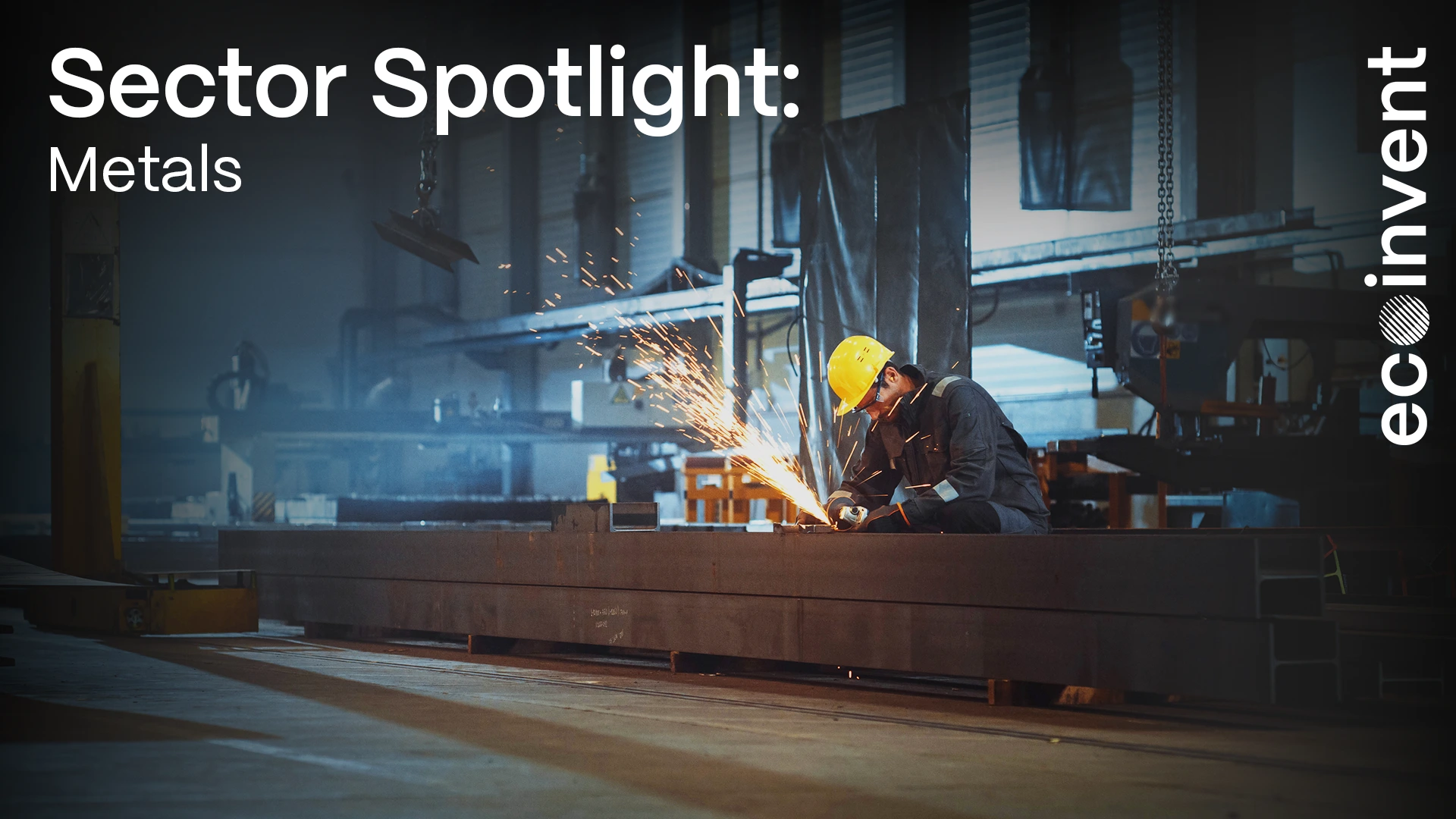
Metal production has been found to contribute approximately 10% of global climate impacts and 12% of particulate matter-related health effects. To better understand the environmental contributions of metal production and processing, rigorous life cycle assessment (LCA) evaluations are vital.


The ecoinvent database provides life cycle inventory data that enables researchers and product designers to understand the environmental impacts of a product or process. The first steps towards creating a more sustainable product or workflow begin with knowledge about where the greatest impacts in the supply chain reside.


In our latest video, Valeria Superti (Project Manager) and Antonella Polimeno Camastra (Data Analyst) describe the data we have available for the metals sector in ecoinvent version 3.11, alongside their support for the operational processes and strategy of the database.


Our database supports environmental assessments in the metals sector with over 400 datasets across twenty geographic regions, documenting processes from the mining and beneficiation of natural resources to the production of metal and mineral commodities, including recycling.


Watch the video now to learn more about our metals sector.

Watch the video:
metals sector spotlight vide thumbnail

Interested in the future of the ecoinvent metals sector? Our latest release, version 3.12, is now available with new and updated information.

Creating regionalized data is essential to improving the accuracy and relevance of life cycle assessment (LCA) studies. Regionalization captures site-specific variations in the geology, technology, energy mix, transport, and regulatory context, and it enables the use of location-specific characterization factors.


The report investigates the continuing role (and limits) of global averages for mining, refining, and smelting, identifying sources and approaches, benefits of regionalized life cycle inventories (LCIs), how processing steps vary by ore and region, and challenges to compiling regional LCIs. It also explores how to compile more geographically representative LCIs, best practices for integrating granular data, and where models could help.


The work screens more than 100 published sources and complements them with fourteen expert interviews to add practical and implementation-focused perspectives.


Regional LCI vs Global Average Datasets

When considering global trends or evaluating a singular operation compared to the average, global average datasets have value when a commodity’s processing is relatively standardized across sites.


However, reliance on global average datasets can lead to significant under- or over-estimation of environmental impacts. For some materials, the process sequence is uniform enough that a global dataset can be serviceable, but where routes and site conditions vary widely, averages quickly become misleading. For example, in the case of lithium, inventories should be built at the process- and site-level to reflect local geology, brine chemistry, energy systems, and operating conditions. This is specifically important for metals used in batteries in light of the EU battery passport, which will become a legal requirement for some battery technologies in 2027.


To create assessments that drive meaningful and sustainable action, greater transparency and accuracy are required. In this report, regionalized data for metals and mining are highlighted as vital for competitive business intelligence and regulatory compliance.


Overall, the study suggests a great need for the regionalization and validation of data, but it also shares the obstacles to overcome before the goals can be achieved, including thoughts on the industry-academia disconnect and regulatory fragmentation.


Read the report now to better understand why regionalized data is essential, alongside key findings that will develop the future life cycle inventory data for metals.

ecoinvent and the Future of Environmental Data

At ecoinvent, we believe that sustainability decisions are only as strong as the data behind them, and that accuracy, transparency, and scientific rigor are mission-critical. Future ecoinvent data releases will bring increased granularity across global value chains by advancing in three key areas:

  • Better regionalized precision
  • Significant scale of high-quality data
  • Greater flexibility and adaptability

To learn more about how ecoinvent will support the future of LCI data across the many sectors of our database, discover the ecoinvent vision with our downloadable whitepaper and webinar recording.

Agricultural, fisheries, and livestock systems play a vital role in biodiversity conservation, biogenic carbon balance and sequestration, and generate value across local and global economies. However, according to IPCC’s Special Report on Climate Change, Desertification, Land Degradation, Sustainable Land Management, Food Security, and Greenhouse Gas Fluxes in Terrestrial Ecosystems, agriculture is responsible for approximately 23% of all human-induced greenhouse gas emissions.


Understanding the many impacts of the processes involved in this sector, of which greenhouse gas emissions are included, can help organizations choose more sustainable outcomes in their value chains.


To achieve a better understanding, ecoinvent data is used by industries, researchers, and policymakers to form a robust foundation for environmental assessments, innovation, and evidence-based decision-making.


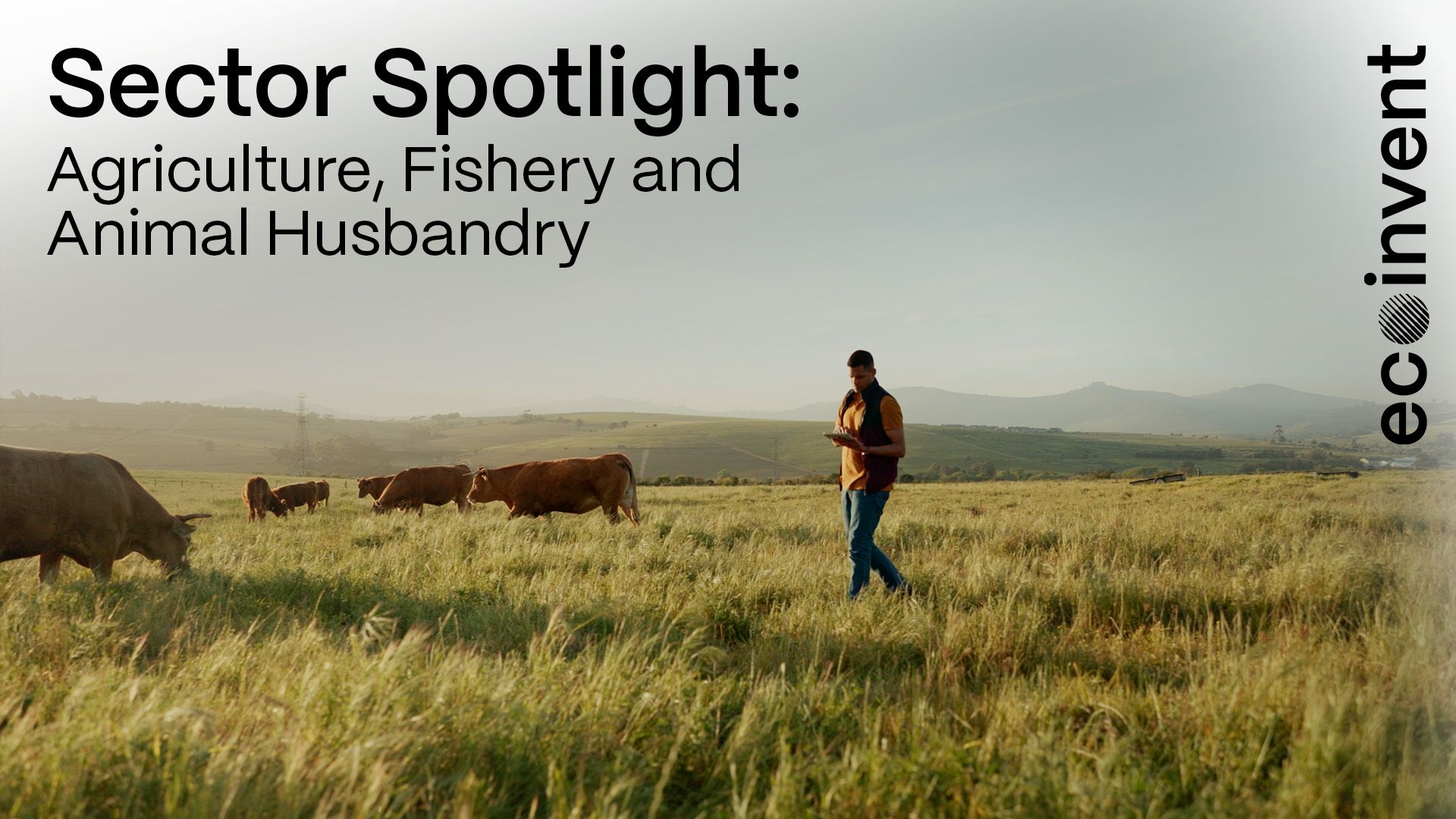
In our latest video, which you can watch below, our agriculture, fisheries, and animal husbandry sector experts at ecoinvent, Francesco Cirone and Andreas Giakoumatos, provide an overview of the ecoinvent database and its developments.


Our database contains over two thousand datasets for agriculture, fisheries, and animal husbandry, covering over four thousand unit processes. This sector plays a central role in ensuring food security, nutrition, and human health, and includes more than 1,200 datasets for crops, more than 900 datasets for fertilizers, pesticides, machinery related to agriculture and irrigation, and almost 200 datasets for animal husbandry and fisheries. This data supports life cycle assessments for various products and services, enabling sustainable decision-making in the value chain.


Within the sector, and of great importance to scientific impact assessments, are several main challenges, such as improving pesticide emission models or balancing biogenic carbon. Our agriculture sector experts are contributing to the discussion through their work on several methodological advancements to improve the data modeling on this topic. They aim to support users in managing the accountability of emissions more precisely.


Our mission is to promote and support the availability of high-quality environmental data worldwide to support informed sustainability decisions.


Watch the video now:
thumbnail sector spotlight agriculture

Discover the agriculture, fisheries, and animal husbandry sector of the ecoinvent database to learn about how our data supports sustainable decision-making for a greener future.

Building and construction is fundamental to the development of civilization, and moving the industry towards more sustainable practices is a must.


Cement is heavily relied upon for building and construction, but it has high environmental impacts and is responsible for 7-8% of all manmade carbon dioxide emissions. The journey towards reducing emissions such as these begins with robust lifecycle data.


Lifecycle data enables researchers and product designers to better understand the environmental impacts of a product or process, and this applies to buildings and construction, too. With knowledge about where the greatest impacts currently reside in the supply chain, smart decisions can be made to create a more sustainable product.


In our latest video, Enrico Bonanno (Project Manager) describes the data we have available for the building and construction sector in ecoinvent version 3.11, alongside his support for the operational processes and strategy of the database.


Our database supports life cycle assessments in the building and construction sector with over 1,500 datasets across fifteen geographic regions, documenting processes from mining construction minerals (sand, gravel, limestone, clay, gypsum) to the production of finished materials.


Watch the video now to learn more about our building and construction sector.

video thumbnail for the building and construction sector spotlight

Interested in using the ecoinvent database? Discover our licensing options today.

Plastics must be responsibly disposed of to prevent environmental harm, and the ecoinvent database can assist in the decision-making process.


Our data enables industry leaders, policymakers, and sustainability experts to fill the gaps in their value chains, enabling more complete life cycle assessments to inform important decisions.


In this video, Avraam Symeonidis (Database Content Lead) provides an expert overview of how the ecoinvent database supports users in the waste industries, specifically regarding plastic recycling data.


Watch the video below to learn Avraam’s insights about the project we undertook with a partner to collect, validate, review, and ultimately publish environmental data related to eleven different polymers from over twenty-five recycling facilities across Europe.

Watch the video:
Waste Sector Deep Dive thumbnail. Plastic & Recycling. Features plastic bottles in factory.

Explore the waste management and recycling sector of the ecoinvent database to learn how high-quality data allows industries to better assess their environmental impacts.

There are many factors to consider when choosing chocolate. Flavor, shape, weight, cocoa percentage, and price are all important, but have you considered the environmental impact of your chocolate? 


Join us on a data-driven journey from the planting of a cocoa bean to the waste treatment of the packaging. Below, we unwrap a Life Cycle Assessment (LCA) conducted by PRé Sustainability, using SimaPro Craft powered by ecoinvent data. The study is structured on an average, 100g Swiss milk chocolate bar, and through it we will show where chocolate’s climate impacts hide. 


Scroll to see what is really inside a chocolate bar’s carbon footprint. 

Building a Chocolate LCA

Discover how ecoinvent data and SimaPro Craft come together to power better sustainability insights!


In this video, we unwrap our LCA of an average Swiss milk chocolate bar. Through this case study, we show how reliable data and accessible tools help reveal environmental impacts from farm to disposal.


Watch now and see how ecoinvent and PRé Sustainability bring sustainability assessments to life.

PRé & ecoinvent collab video thumbnail chocolate lca

Discover the potential of an ecoinvent license today. Contact us to learn how ecoinvent’s life cycle inventory database can turn sustainability questions into data-driven answers.

The detailed representation of the chemical sector’s value chain in the ecoinvent database empowers industries to make data-driven decisions for more sustainable practices. In our latest video, our experts Daria Dellenbach (Project Manager) and Iasonas Ioannou (Project Manager) describe how they contribute to the operational processes and strategy of our database to ensure a reliable and comprehensive chemicals sector.


Our database contains over 750 unique chemical products, including over 450 basic chemicals, 95 types of plastics and rubber, and 83 agrochemicals. This data supports life cycle assessments for various products and services, enabling sustainable decision-making in the value chain.


Our mission is to promote and support the availability of high-quality environmental data worldwide to support informed sustainability decisions. Our latest release, version 3.11, is coming soon with new and updated information for the chemical sector.
Watch the video now:
Video thumbnail for chemicals sector spotlight video. Shows a field.

Explore the chemicals and plastics sector of the ecoinvent database to learn how high-quality data allows industries to better assess their environmental impacts.

Batteries power our everyday lives, from mobile phones to electric cars. At ecoinvent, we are committed to expanding our batteries sector and ensuring it is up to date.


At the heart of this discussion is how industries can make batteries themselves more sustainable, particularly regarding electric vehicles (EVs). Often promoted as a cleaner, greener way to travel privately, EV sales surged by 35% in 2022, but answers to the disposal and recycling of EV batteries are still strongly sought after.


High-quality, scientific data will be integral to the effort to optimize sustainable outcomes in battery production and disposal. The ecoinvent database provides annually updated data on many aspects of the battery supply chain, including treatment and recycling at the end-of-life phase.


The ecoinvent database contains over one hundred datasets for the batteries sector, including lithium, iron, and phosphate battery technology, and datasets on individual battery components such as cathodes, anodes, battery management systems, and more. This data supports life cycle assessments, carbon footprint calculations, and Environmental Product Declarations (EPDs) for various products and services.


In our latest video, which you can watch below, our battery experts present more information on this topic. Meet Lauriane Bichot, Data Analyst, and Antonio Valente, Project Manager, in their element as they describe batteries sector developments and the ecoinvent database.


As we work towards a more sustainable future, the ecoinvent database will continue to expand to better serve the needs of its communities. We are committed to our mission of enabling our users to understand the environmental impact of their products and to make informed decisions.

Watch the video now:
Battery factory image with text: 'Sector Spotlight: Batteries'.

Discover the batteries sector of the ecoinvent database to learn how our data supports sustainable decision-making in battery production and use.

Life cycle assessments are fundamental for effective sustainability action—from comparing the environmental impacts of similar products to highlighting critical emissions in the production, use, or end-of-life phase of a product or service.


In our short video, we use the ecoinvent database to calculate the total global warming potential associated with the production and shipping of a simple bamboo toothbrush, its cardboard packaging, and its shipment to Zurich.


This is a cradle-to-gate analysis, meaning that the video covers the beginning of the supply chain up to the point of use. We do not cover the emissions created by the use or disposal of the toothbrush.

Watch the video
Graphic banner, green, reads: 'Case Study: Life Cycle Assessment of a Bamboo Toothbrush'

Learn more about our license offerings

ecoinvent licenses
graphic of life cycle assessment results for Hyperloop, Train, Aircraft e-kerosone, and aircraft conventional

This paper, a collaborative effort* between five researchers from the PSI Laboratory for Energy Systems Analysis (LEA) and the EuroTube Foundation, comprehensively evaluates the environmental impacts of hyperloop systems, a novel transportation concept poised to revolutionize long-distance travel.


The global transportation sector is a significant contributor to greenhouse gas (GHG) emissions, and with increasing demand for air travel and the ongoing challenges in decarbonizing the aviation sector, finding sustainable alternatives is crucial. While rail systems offer a more environmentally friendly option, they face limitations, particularly regarding capacity and infrastructure needs. New transportation technologies like the hyperloop promise to combine the speed of air travel with the low environmental impact of rail systems.

What is a Hyperloop?

A hyperloop is a high-speed transportation system that utilizes magnetic levitation to propel pods along tracks within low-pressure tubes. These tubes, typically made of concrete or steel, create a near-vacuum environment that minimizes friction and aerodynamic drag. The result is a transportation system capable of moving both passengers and cargo at unprecedented speeds with minimal energy consumption.

Life Cycle Assessment: A Comprehensive Evaluation of Hyperloop Systems

This research represents the first comprehensive life cycle assessment (LCA) of a hyperloop system, comparing its environmental impact to that of high-speed trains and aircraft within a European context. The results are promising: hyperloops can be a highly energy-efficient, low-carbon alternative to traditional high-speed travel.


The study found that the emissions associated with hyperloop systems travel over their entire life cycle are comparable to those of trains, provided that the electricity used is from low-emission sources and that the hyperloop achieves high occupancy rates.


This in-depth analysis was made possible through the novel application of Integrated Assessment Models (IAM), coupled with the Swiss Energy Perspective 2050+ and the ecoinvent database within the ‘premise’ modeling framework.


The findings of this study suggest that hyperloop could indeed be a key component of future sustainable transportation networks, offering a solution that bridges the gap between the speed of air travel and the environmental benefits of rail systems.


We are proud of Paul and Christian’s contributions to this vital research and look forward to further exploring the potential of hyperloop systems as part of a sustainable future.


*Paul Beckert and Christian Bauer participated in this project as researchers at PSI. ecoinvent was not directly involved in this research project as a collaborator.