Many large listed companies in Switzerland have made significant progress on sustainability measurements and disclosures. 


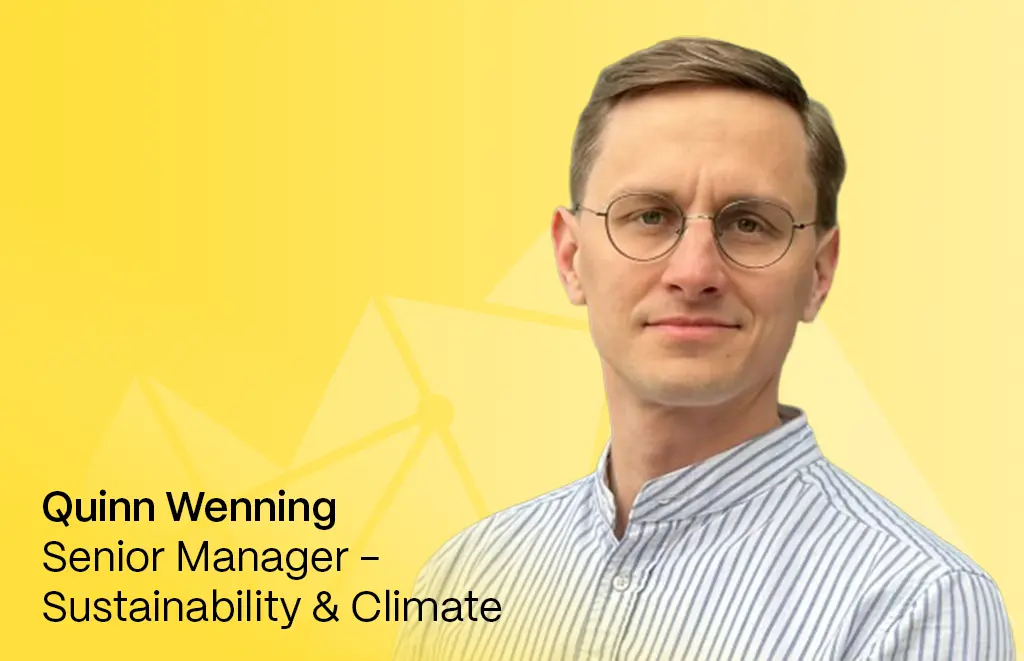
What’s often missing is a clear path from that data to the decisions that matter for a business. Quinn Wenning, Senior Manager – Sustainability & Climate at Deloitte in Switzerland, works on creating that path, and his assessment is: the problem is not the data itself, it’s how it translates into business decisions.   


As one of Switzerland’s leading professional services firms, Deloitte Switzerland advises companies on complex business challenges, including sustainability, across audit and assurance, consultancy, tax, legal, and risk. According to their  State of Sustainability Reporting FY25 market study, about 96% of top companies in the Swiss index have Scope 1, 2, and at least partial Scope 3 coverage. 


“The question isn’t only how do we get better data, though that’s clearly part of the challenge. It’s how do we get the right data into the rooms where the decisions are being made,” says Quinn.


This framing defines Deloitte’s approach to sustainability consulting. It points to a problem that is fundamentally about language. 

The Challenge: Data that Doesn’t Speak the Language of the Room

When Quinn walks into a new client engagement, the conversation often starts from the same place. Companies have data, but it isn’t making the impact they want it to make.  


The complexity, he argues, goes deeper. Product teams need product-level granularity but are working with sector averages. Sustainability data sits in systems that don’t communicate with each other. Sometimes, the sustainability team is siloed, doing important work that never reaches the people authorized to act on it.  


Even where data does reach the right rooms, it often arrives in the wrong language. Sustainability professionals think in tons of CO2, greenhouse gas emissions, and life cycle assessment outputs, whereas CEOs and CFOs think in euros, dollars, and francs, and procurement managers think in cost per unit. The translation between those vocabularies is not automatic, and without it, sustainability reporting produces “nodding in boardrooms” rather than decisions.   


It’s our job to translate sustainability information to a financial value at risk, or carbon intensity into a procurement decision,” says Quinn. “And I think that translation, not only the measurement, is how embedding sustainability truly starts to click at companies.”


Deloitte has recently developed the Sustainability Fusion framework to help effectively communicate the business case.  


According to Quinn, only a quarter to half of companies in Switzerland are financially quantifying their climate-related financial risks (see page 24). This figure highlights how many sustainability teams are still having a different conversation from the one happening in the boardroom. 

The Solution: What Changes when Sustainability Speaks the Right Language 

Deloitte’s Sustainability Fusion framework does exactly that: it bridges those language gaps and turns sustainability data into business decisions. Deloitte’s practice is built around a straightforward mechanism: take sustainability data and translate it into the financial and operational terms that trigger decisions in their respective audiences.  


For boards and executives, that means crossing carbon emissions with carbon price projections and embedding the result in a CapEx (Capital Expenditure) or OpEx (Operating Expenditure) plan. When that happens, something shifts.   


“It becomes a line in a spreadsheet that’s comparable to everything else in that decision-making. And then the reaction that we see is, ‘Oh, this is a business problem.'” Quinn explains.


For Quinn, the moment a CEO or CFO recognizes sustainability as a business problem rather than a reporting obligation is a win. These are people who are motivated by business problems. Framing sustainability in those terms gives them a reason to engage rather than defer.  


The distinction matters at the organizational level, too. Quinn uses an example of a company whose head of sustainability, when asked how his sustainability strategy was going, replied simply: “We don’t have a sustainability strategy. We have a sustainable business strategy.”   


“That difference,” Quinn argues, “matters tremendously. Because a sustainability strategy lives within a function, but a sustainable business strategy, that’s something that moves the company. It’s a lens with which procurement can make decisions. It’s something that the product teams can use. It’s something that finance can use.” 


At a company level, this kind of integration is still rare. But Quinn often sees it emerging in individual groups and functions and expects it to accelerate as organizations begin to tackle Scope 3 in earnest, because this ultimately is impacting everyone in the organization and in the supply chain. 

Translation to Action in Practice: The Hotspot Example

Once the translation is in place—once sustainability data is speaking the language of the room—the decisions that follow are often faster and more commercially grounded than the sustainability team expected.  


Quinn describes working with one company that shipped significant volumes of heavy equipment by air freight. The team knew it was a major source of emissions. The translation work revealed that it was also extremely expensive, roughly ten times the cost of sea shipping for the same volume. The sustainability problem and the cost problem were the same problem.   


“This company set up a few internal incentives to get the product managers willing to spend that extra time to ship it by sea,” Quinn explains. “By doing so, they’re saving about ten times on the shipping costs, and the emissions associated with sea shipping versus air shipping are also a ten times improvement a lot of the time. So that’s a great win for the internal logistics team, and it’s a great win for the sustainability team.”


This example illustrates a pattern Quinn sees repeatedly: when emissions data is embedded in operational workflows and expressed in operational terms, hotspots become visible that were previously invisible. Not because the data wasn’t there, but because no one had built the connection between the sustainability system and the system where the commercial decision was being made. This is where the need for Deloitte’s sustainability translation comes in. 

The Structural Barriers that Remain  

The translation problem is not just methodological; it is also structural and personal. 


Inside organizations, the incentive structures may not reward the people doing the translation work. Sustainability practitioners are taking on career risk when they push for decisions that have not yet been recognized internally.  


“Within organizations, a lot of times what’s missing is the internal incentivization, the remuneration.” Quinn points out. “This is key because there’s a career risk. People are putting themselves on the line, and we can’t forget that.”


A second barrier is framework-level. Companies have held back on certain sustainability topics because they haven’t been able to make credible claims on the actions they’ve taken. Emerging frameworks are beginning to address this, creating clearer standards for what counts, what can be claimed, and how to report it in ways that hold up externally.  


Quinn’s recommendation for getting through these barriers is focus. Not narrowing sustainability ambition, but disciplined prioritization of where translation work will have the most immediate impact. That means converting existing data into risk, cost, and value terms, and then carrying those translated insights in three directions: up to boards and executives, out to customers, and back through the supply chain to suppliers. The full impact of sustainability, Quinn argues, only materializes when all three conversations are happening at once. 

The Bigger Shift: The Data Behind the Translation

The work to better position sustainability internally that Quinn describes is only credible if the data being translated is accurate. When a CFO sees carbon emissions expressed as a line in a CapEx plan, the credibility of that number, and the subsequent decision, depends entirely on the quality of the emission factors used to calculate it. 


Deloitte’s sustainability consultants are equipped with ecoinvent data, and ecoinvent data powers an internal Deloitte platform; supporting services across sustainability strategy and transformation, decarbonization, regulatory compliance, and supply chain management. That data foundation gives Deloitte’s translation its credibility, ensuring that when sustainability data enters a boardroom conversation, the numbers behind it hold up.   

See Quinn Wenning and other sustainability leaders discuss their work in our panel recording: Beyond the Pledge: Embedding Sustainability into Business DNA.


To explore working withecoinvent,contact our team.