Johnson Gui Founder and CEO of HiQLCD

JimuLCA, developed by E-C Digital (HiQLCD’s parent company), is China’s largest LCA solution provider—purpose-built for the sectors that need it most. As ecoinvent’s authorized partner in China, HiQLCD delivers the world’s most trusted life cycle inventory (LCI) data through private cloud and enterprise deployments designed for Chinese business environments.


In this interview, Johnson Gui describes sustainability in China, the Jimu LCA tool’s block-based approach, and the digital and AI innovations behind their progress. Ondrej Szabo, in turn, provides insights on the Chinese sustainability market, why the partnership between ecoinvent and HiQLCD is so important, and how the two organizations have jointly developed innovative private cloud solutions to deliver ecoinvent data to Chinese enterprises.


Read on to discover where HiQLCD meets ecoinvent.

Introducing Johnson Gui

Johnson’s sustainability background includes experiences from around the world, which helped to build his wide-reaching perspective on LCA.


His career has been a single, unbroken thread: making environmental assessment work inside real industry. From studying environmental engineering in China and industrial ecology in Sweden, to working at ArcelorMittal in France and Baosteel in China—the world’s two largest steelmakers—he has stayed at the exact point where LCA meets the factory floor.


Johnson has explored how digital and information technologies could be combined with traditional LCA and consulting approaches. He seeks to support small and medium-sized enterprises in managing their carbon footprints and broader sustainability issues through technology.


This motivation led Johnson to found E-C Digital and HiQLCD. Their vision is to apply digital and AI technologies to make LCA easier to use, more accessible, and more affordable.


Introducing Ondrej Szabo

Ondrej has a professional background in managing and leading go-to-market motions for data businesses. Before joining ecoinvent in 2024, he was a newcomer to the sustainability sector.


His core experiences are at the helm of translating, transforming, and future-proofing legacy data businesses into Data as a Service (DaaS). Today, his work is focused on running data businesses successfully in the age of AI.

Johnson, your product, Jimu, has an interesting translation in English. Can you tell us the story behind it?

Our company has a clear vision: we use digital and AI technologies to translate professional sustainability and LCA knowledge into tools that are practical and easy for non-specialists to use.


We initially focused on the steel sector, where we developed a sector-specific LCA tool called Jimu Life Cycle Assessment. “Jimu” means Lego in English, and the idea is similar: each “block” represents the smallest unit process, such as a specific piece of equipment. We standardize industrial equipment and processes into these digital blocks, which are already linked to LCA data, product category rules (PCRs), and allocation methodologies.


This block-based approach allows engineers inside a company—such as EHS or ESG engineers who are not LCA specialists—to complete highly professional LCA calculations. At the same time, it significantly reduces costs, as traditional LCA software can be prohibitively expensive for small and medium-sized enterprises in China.


This solution was quickly adopted by the market after our 2017 launch, and we now serve roughly two-thirds of the steel sector. We then realized that the Jimu “block” concept could be applied to other industries as well. From there, we expanded into the power sector and now cover a wide range of manufacturing industries, including batteries, electric vehicles, and solar panels. This marked the first phase of our company’s development.


As we continued to grow, we recognized another major challenge: for most companies, 70–80% of emissions come from Scope 3 sources. While our tools are strong in on-site data collection and modeling, accurate Scope 3 assessments also require high-quality background databases. Despite China being a global manufacturing hub, there is still a lack of reliable and localized life cycle data.


Our long-term goal is to build a Chinese-specific life cycle inventory (LCI) database that meets the same principles of transparency, quality, and continuous improvement that organizations like ecoinvent have upheld for decades.  In many ways, ecoinvent has served as a benchmark and a teacher for us in how high-quality databases should be developed and maintained.

Johnson Gui LCA Interview quote

Ondrej, from your perspective, what are the key advantages of the collaboration between ecoinvent and HiQLCD?

China is fueling the global economy as the center of production. Therefore, to achieve a more sustainable planet, enabling users and businesses of all sizes in China to access science-backed environmental data is paramount.


China is a challenging market for Swiss and European enterprises to enter, which is why finding valuable partnerships is so important. Johnson and I have known each other for over a year now, and I’m grateful for the several roundtables in Shanghai he has hosted with stakeholders from the industry, government, and sustainability sphere, because it all informs ecoinvent’s strategy.


As Johnson has previously stated, we need to ensure that we’re not just delivering factors or numbers that somebody can use to create a report. We want to provide the market with actionable, high-quality data that can be used to decarbonize the industry.


Johnson, what is the main challenge in the Chinese market that you are working to address?

One of the biggest challenges in China today is that sustainability has become very popular very quickly. There is a strong commitment and clear direction from the Chinese government to make the economy more sustainable—but turning that ambition into real, credible action at the company and factory level is not easy.


In the early stages, many organizations claimed they could provide carbon footprint or sustainability solutions, but the underlying methodologies varied widely. Some companies calculated emissions using only organizational Scope 1 and 2 data, while others relied on emission factors collected from websites, articles, or secondary sources without proper validation. As a result, companies were producing numbers—but the key question was whether those numbers were trustworthy and usable.


Building accurate models takes time, deep industry understanding, and close cooperation with companies across different sectors. Fortunately, China’s manufacturing ecosystem is also our strength. China has one of the most complete industrial supply chains in the world—producing more than half of global steel, a significant share of aluminum, and dominating key areas including batteries and rare earth materials. This gives us the opportunity to build high-quality, sector-specific data blocks—but it still requires time and sustained effort.


Another major challenge is the expectation around speed. There is a strong cultural drive in China to move fast and deliver results quickly. However, when building a high-quality life cycle database, speed cannot come at the expense of quality.


ecoinvent and other European pioneers have spent decades building, refining, and continuously updating their databases. High-quality data is not created overnight. Together with partners like ecoinvent, we believe there is still important education work to be done—across government, industry, and the broader stakeholder community—to align expectations around what “quality” really means in sustainability data.


Johnson, tell us about HiQLCD – A Purpose-Built LCA Database for China

We clearly separate our tools from our data. Our LCA software platform, Jimu LCA, draws its background data primarily from HiQLCD.


In a narrow sense, HiQLCD can be understood as a China-specific LCI database. In a broader sense, it is designed to support global supply chains and international trade. In today’s interconnected economy, a single country’s database is often not sufficient, so high-quality, interoperable LCI data is essential.


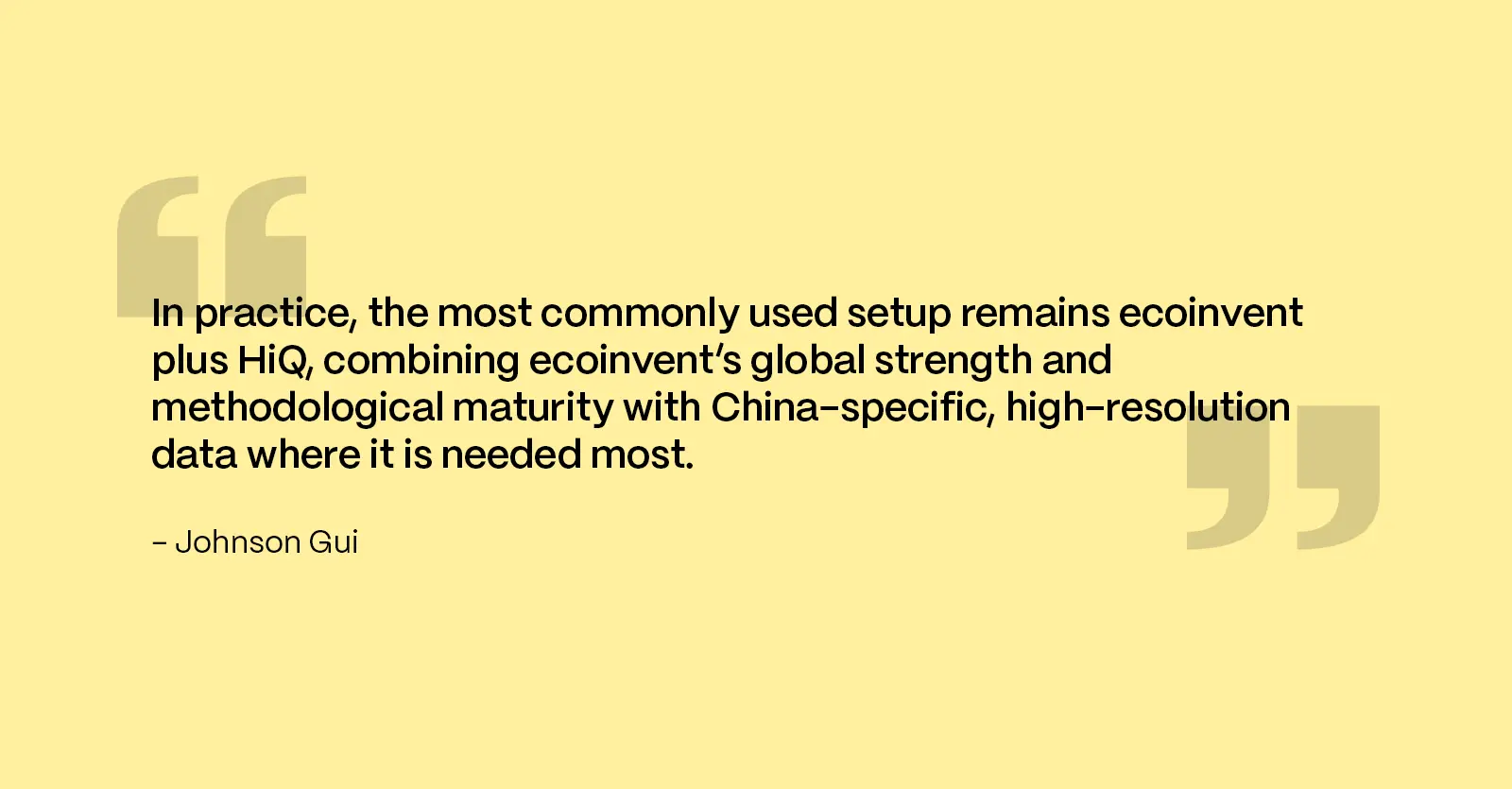
In practice, the most commonly used setup remains ecoinvent plus HiQ, combining ecoinvent’s global strength and methodological maturity with China-specific, high-resolution data where it is needed most. We can also integrate other specialized sector databases depending on the application. However, for most users in China, ecoinvent and HiQLCD form the core data foundation.


HiQLCD serves as the database solution behind tools like Jimu LCA, but it is not limited to our own software. While Jimu LCA currently holds a significant market share, the Chinese market is diverse, with many AI-driven and customized digital platforms in use. For that reason, HiQLCD is designed to be open and compatible with a broader ecosystem. Our long-term ambition is not only to use ecoinvent data for disclosure and quantification, but also to work more closely with the global community.


Today, we provide HiQLCD to our own tools, government systems, industrial platforms, and other local LCA and sustainability solutions.


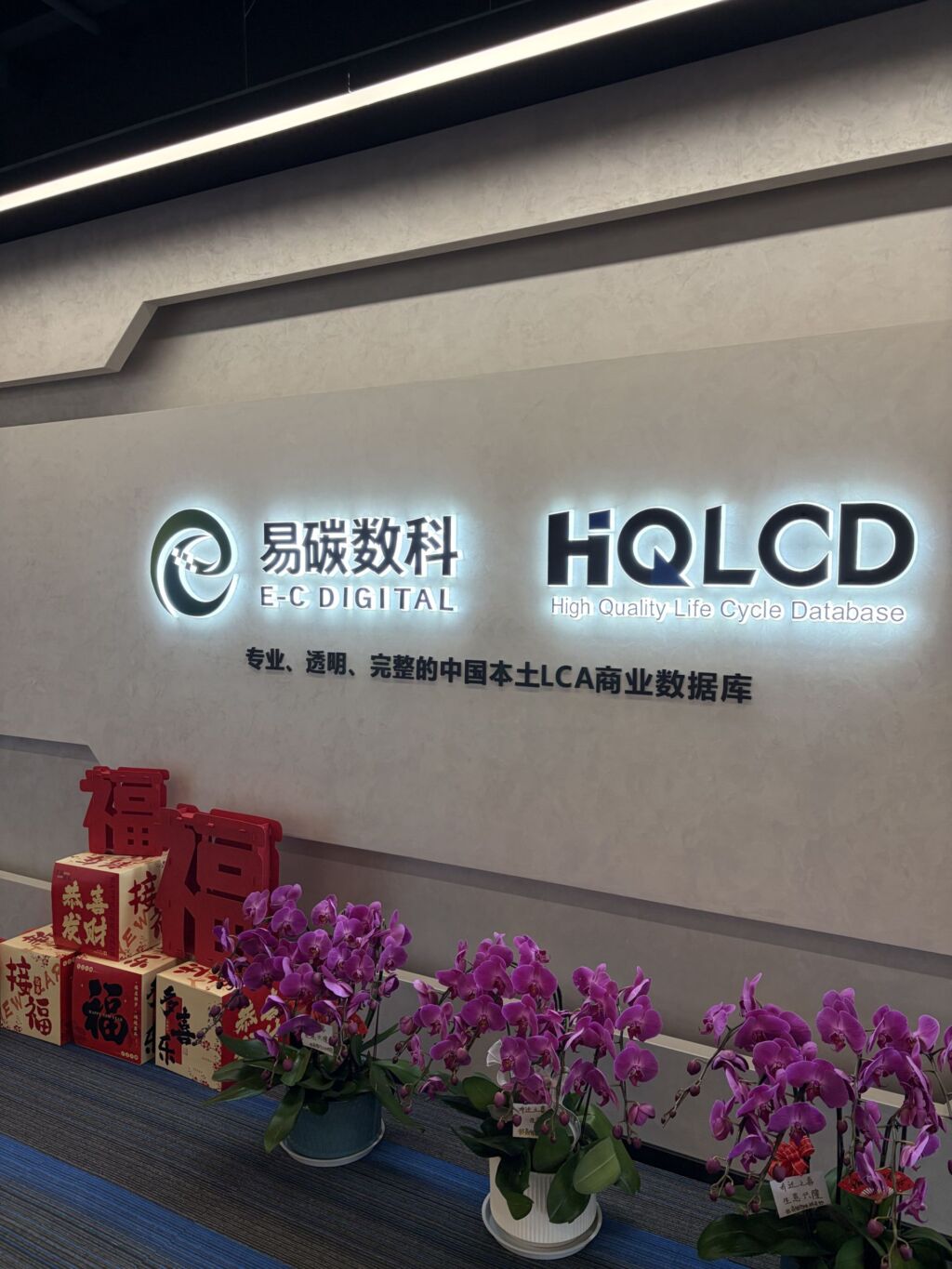
HiQLCD and EC Digital logos in office

The HiQLCD Office

Johnson Gui LCA Interview quote

Ondrej, looking ahead, what further developments do you envision to strengthen and expand the collaboration?

Powering the Jimu LCA tool with ecoinvent data is already a major step forward, but we need to think bigger. China’s carbon-intensive industries are represented by huge, partially state-owned enterprises. We need to find new, innovative licensing models. Think bigger, better. This will ultimately support Johnson in selling enterprise cloud applications to these critical players.


Finally, the next step is to sit together and think more broadly about combining data assets across geographies, and then to ensure a productive and forward-looking approach regarding AI applications.


Johnson, what qualities are your customers looking for when it comes to their data?

Customer expectations around data quality have evolved significantly. In the past, many companies simply wanted a carbon footprint value. As long as they had a number expressed in CO₂ equivalent, that was considered sufficient.


Today, that mindset has changed. More and more clients care deeply about the quality of the underlying data—not just the final value, but what sits behind it. They want to understand the data sources, the assumptions, the modeling approach, and whether the results are credible and defensible.


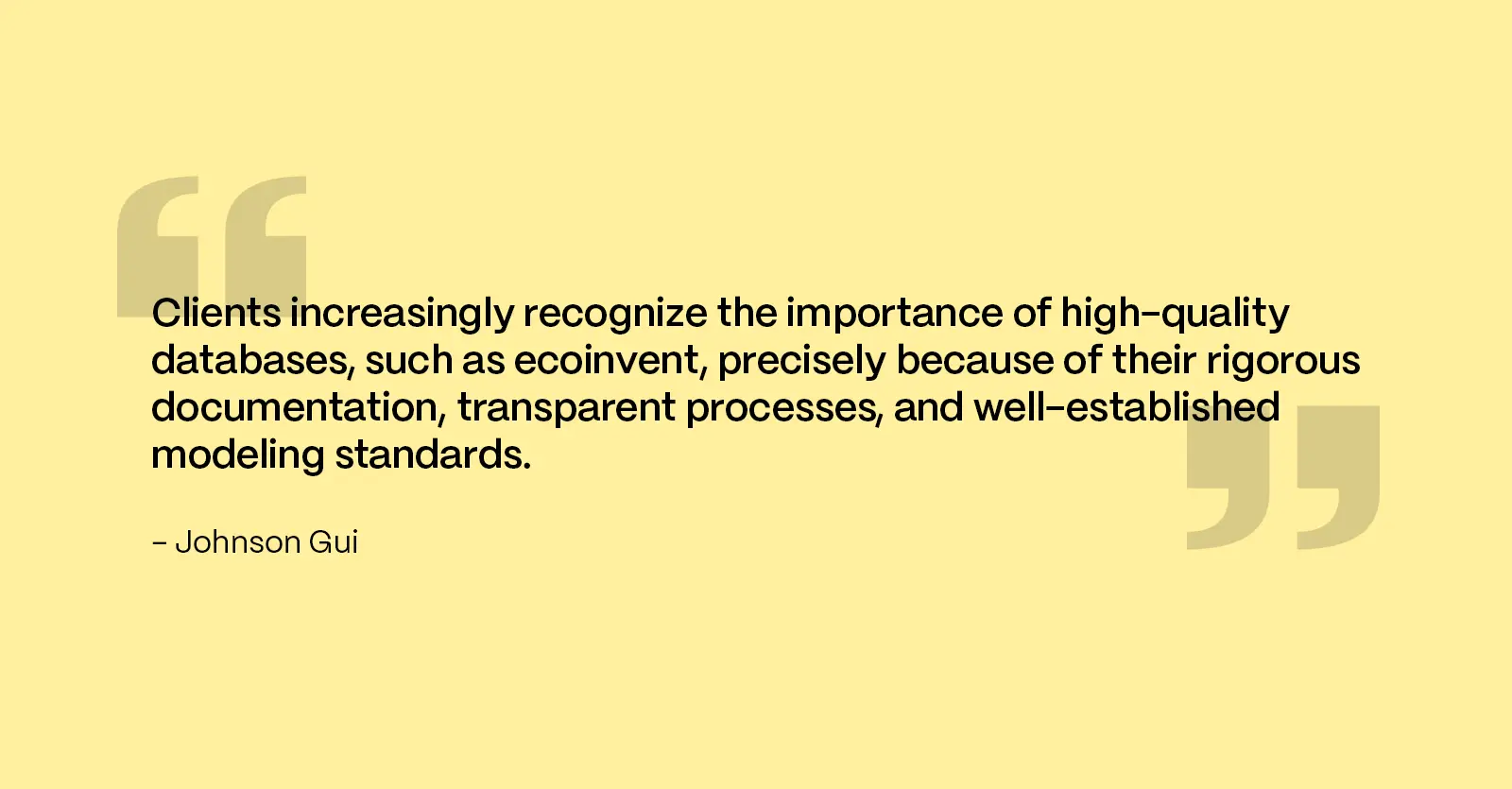
As a result, transparency, full documentation, and consistent methodology have become key requirements. Clients increasingly recognize the importance of high-quality databases, such as ecoinvent, precisely because of their rigorous documentation, transparent processes, and well-established modeling standards.

Johnson Gui LCA Interview quote

This shift is also shaping our own work. We are focused on providing high-quality, well-documented data to the market, aligned with the same principles of consistency and transparency. In this context, ecoinvent is widely regarded as the leading reference, and its acceptance in the Chinese market continues to grow.


At the same time, data quality alone is not enough. Proper use of high-quality databases requires education and clear guidance. In many cases, Chinese clients are willing to use these databases correctly, but they need better explanations, training, and support. As adoption increases, providing education and sharing best practices across the community becomes just as important as the data itself.


Johnson, can you provide some examples of how your customers leverage your technology to meet their sustainability goals?

Today, most of our enterprise customers require private cloud or on-premise deployments. This is a distinctive feature of the Chinese market—large companies need their LCA and carbon management systems to be fully integrated into their internal IT infrastructure, with ecoinvent data securely embedded within their own environments. Working closely with ecoinvent, we have developed a private cloud solution that meets these requirements while maintaining full data integrity and licensing compliance.


A good example is our work with Baosteel. Together, we developed what we believe is the first real-time carbon labeling system in the steel industry. Before this system was implemented, Baosteel had a dedicated LCA team of five people who could calculate the carbon footprint of about nine complex steel products per year. Annual updates were already difficult, as the calculations were done using traditional LCA software.


After implementing the real-time carbon labeling system, Baosteel can now calculate the carbon footprint of approximately 330,000 steel products per month at just one factory—the Baoshan facility. This factory alone produces close to 10 million tons of steel per year. Compared to fewer than ten products annually, this represents a dramatic improvement in both scale and efficiency.


The system has been verified by TÜV and integrates data from more than twenty internal systems, including financial systems, energy and environmental systems, manufacturing execution systems (MES), and supply chain systems. These data are collected, cleaned, preprocessed and then fed directly into the LCA models, enabling near real-time results. This will also be very valuable for regulators and local governments. More granular and up-to-date data support better decision-making, more accurate management, and more effective progress toward sustainability goals.


We see a clear trend: industry leaders are moving toward real-time, high-resolution carbon labeling systems. These systems go beyond traditional LCA software by providing faster, more granular results and enabling batch- or contract-based carbon footprint calculations.

Johnson Gui LCA Interview quote

Looking ahead, we believe real-time carbon labeling will become a standard requirement for new factories and production systems. From around 2027, local governments in China are also expected to introduce clearer requirements related to carbon emissions and carbon intensity at the regional level. These requirements will be passed down to individual companies and even reflected in management KPIs.


Johnson, tell us about your latest package for corporate businesses, how ecoinvent data is involved, and the benefits for your users.

ecoinvent is widely recognized as one of the most reputable and high-quality life cycle databases in the world, and we consider ourselves very fortunate to work closely with ecoinvent to bring this level of data quality to the Chinese market.


As ecoinvent’s authorized partner in China, we are currently the only company that offers ecoinvent data through fully compliant licensing structures with transparent pricing and clear policies tailored to local market requirements. Together with ecoinvent, we have also innovated a private cloud deployment model that allows large enterprises to integrate ecoinvent data securely within their own IT infrastructure—a critical requirement for corporate clients that place a strong emphasis on intellectual property protection, data security, and regulatory compliance. For these companies, using high-quality and well-documented data through authorized channels is not optional—it is essential.

Johnson Gui LCA Interview quoteFor that reason, we prioritize ecoinvent data across our corporate packages, alongside our own high-accuracy datasets where appropriate. Our approach is to maintain quality step by step, rather than relying on generic emission factors or low-transparency databases. For us, ecoinvent represents quality, credibility, and long-term trust.

 

Beyond large enterprises, we are also focused on accessibility. Last year in Shanghai, we worked to integrate ecoinvent data into a local public service platform, allowing more small and medium-sized enterprises to access professional LCA calculations. While industry leaders often have dedicated LCA teams and already understand the value of ecoinvent, smaller companies typically lack these resources—even though medium-sized private enterprises account for around 70% of employment and a significant share of real economic activity.


Ultimately, we believe ecoinvent is the reference choice for high-quality, general-purpose LCA databases. As ecoinvent’s authorized partner in China, we are committed to helping companies of all sizes access, subscribe to, and properly use ecoinvent data. Looking ahead, we hope to deepen our collaboration further—expanding both the reach and the depth of ecoinvent’s presence in the Chinese market, and ensuring that sustainability data of the highest quality is available to every company that needs it.


Johnson, what is your team looking forward to in the next year or two?

Over the next year or two, our focus is on two main priorities.


First, we want to continue educating the market and expanding access to professional LCA methodologies and high-quality databases. Many of these companies do not have in-house LCA expertise or the resources to build dedicated sustainability teams. Helping them adopt credible, professional approaches to sustainability remains a key goal for us.

Second, we are actively exploring how AI technologies can be applied to LCA and sustainability more broadly. Our aim is to use AI to make LCA tools even more accessible, efficient, and affordable, without compromising data quality or methodological rigor. We see significant potential in this area in the near term.


Beyond China, we also hope that more companies globally—especially those directly or indirectly connected to Chinese supply chains—will benefit from access to more granular, up-to-date, and China-specific life cycle data. Supporting better decision-making across global value chains is an important part of our longer-term vision.


Interested in becoming an ecoinvent partner? Contact us.

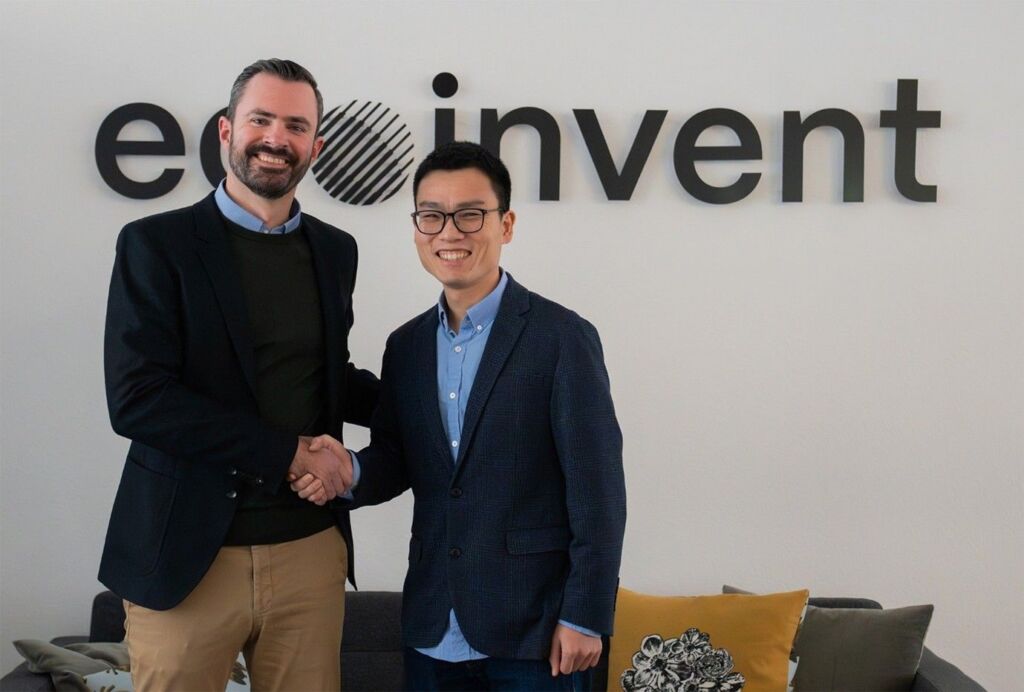
Ondrej Szabo (ecoinvent) and Johnson Gui (HiQLCD) meeting.